Introduction to Reinforcement Learning
Imagine teaching a dog new tricks, but with computers and robots instead! That's what Reinforcement Learning is all about. It's a way for computers to learn by trying things out and getting rewards or penalties based on their actions.
Reinforcement Learning (RL) is one of the most exciting areas of Artificial Intelligence. Unlike other types of machine learning where computers learn from existing data, in reinforcement learning, the computer learns by interacting with its environment and receiving feedback.
Think about how you learn to play a new video game. At first, you might not know what to do, but as you play, you figure out which actions earn you points and which ones cost you lives. That's exactly how reinforcement learning works!
Key Concepts of Reinforcement Learning
Agent
The agent is the learner or decision-maker. It could be a robot, a character in a game, or a computer program. The agent observes its environment, makes decisions, takes actions, and learns from the results.
Environment
The environment is everything the agent interacts with. It could be a physical space (like a maze), a virtual world (like a video game), or any system the agent needs to navigate or control.
State
A state represents the current situation of the agent in its environment. For example, in a maze, the state might be the agent's current position.
Action
Actions are what the agent can do. In a maze, actions might include moving up, down, left, or right. The agent chooses actions based on its current state.
Reward
After taking an action, the agent receives a reward (or penalty). This feedback tells the agent how good or bad its action was. The goal of the agent is to maximize its total rewards over time.
Policy
A policy is the strategy that the agent uses to decide which action to take in each state. It's like a rulebook that guides the agent's behavior.
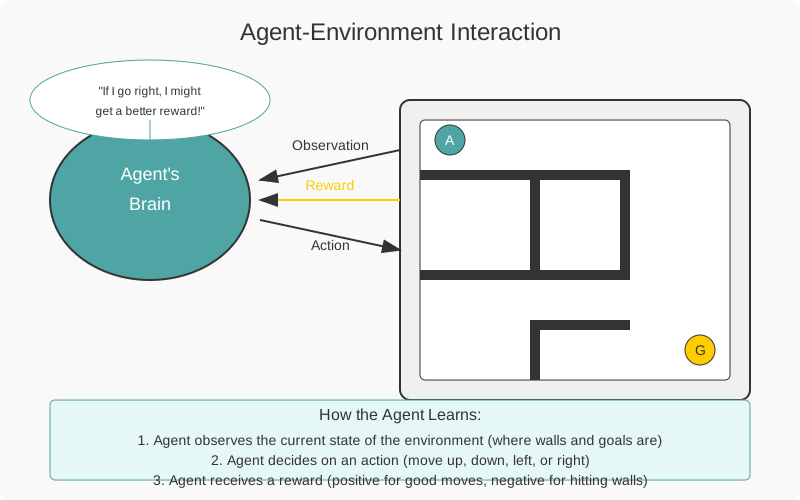
The Reinforcement Learning Loop
The RL process works in a continuous loop:
- The agent observes the current state of the environment
- Based on this state, the agent chooses an action to take
- The environment changes to a new state based on the action
- The agent receives a reward (positive or negative) for its action
- The agent learns from this experience and updates its strategy
- The process repeats, with the agent getting better over time
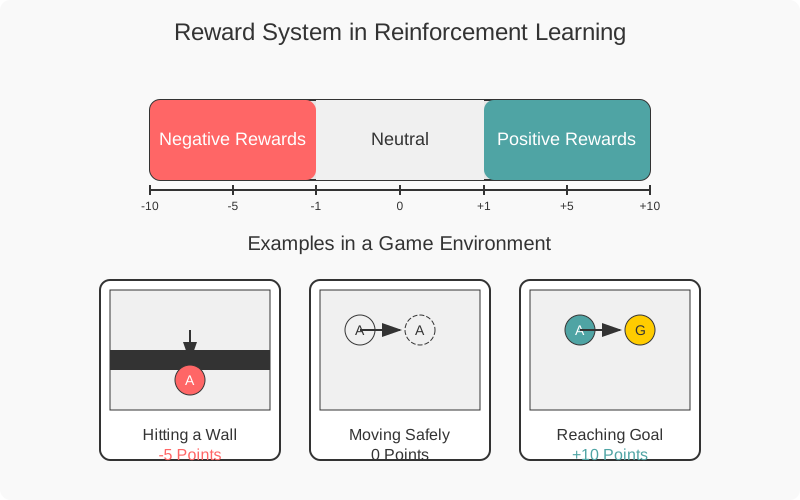
Interactive Example: The Maze Explorer
Let's see reinforcement learning in action! In this example, an AI agent will learn to navigate through a maze to reach a goal. You can control the agent manually or watch it learn automatically.
How it works: The agent receives rewards and penalties based on its actions:
- +10 points for reaching the goal (yellow circle)
- -5 points for hitting a wall
- -0.1 points for each move (to encourage efficiency)
The colored arrows show the agent's learned values for each possible action. Greener arrows indicate actions the agent thinks will lead to higher rewards.
Real-World Applications
Reinforcement learning isn't just for games and mazes. It's used in many real-world applications that affect our daily lives:
Video Games
RL is used to create intelligent opponents in games like chess, Go, and video games. In 2016, AlphaGo (an AI using reinforcement learning) defeated the world champion Go player, a feat previously thought to be decades away.
Game developers use RL to create more challenging and realistic non-player characters (NPCs) that can adapt to different player strategies.
Robotics
Robots use reinforcement learning to master complex tasks like walking, grasping objects, or navigating through challenging environments. Unlike traditional programming, RL allows robots to adapt to unexpected situations.
Boston Dynamics' robots use RL techniques to maintain balance and perform acrobatic movements that would be nearly impossible to program manually.
Self-Driving Cars
Autonomous vehicles use reinforcement learning to make driving decisions. The cars learn from millions of simulated and real driving scenarios to navigate safely in complex traffic situations.
RL helps self-driving cars predict the behavior of other vehicles and pedestrians, allowing them to make safer decisions in real-time.
Recommendation Systems
Ever wonder how TikTok, YouTube, or Netflix seem to know what videos you'll like? They use reinforcement learning! These systems learn from your interactions (likes, views, time spent watching) to recommend content you're likely to enjoy.
The more you use these platforms, the better they get at predicting your preferences, creating a personalized experience.
The Science Behind RL
While the concept of reinforcement learning is simple to understand, the mathematics and algorithms behind it can be quite complex. Here's a simplified explanation of how it works:
Q-Learning: A Popular RL Algorithm
One of the most common reinforcement learning algorithms is called Q-Learning. The "Q" stands for "quality" - as in, the quality or value of taking a specific action in a specific state.
The algorithm creates a table (called a Q-table) that stores values for each state-action pair. These values represent how good it is to take a particular action in a particular state.
As the agent explores its environment, it updates these Q-values based on the rewards it receives. Over time, the Q-table becomes a kind of "map" that guides the agent to make better decisions.
Exploration vs. Exploitation
A key challenge in reinforcement learning is balancing exploration and exploitation:
- Exploration: Trying new actions to discover potentially better strategies
- Exploitation: Using what you've already learned to get the best reward
It's like trying a new restaurant (exploration) versus going to your favorite place (exploitation). If you always go to your favorite restaurant, you might miss out on discovering an even better one!
RL algorithms use various strategies to balance exploration and exploitation, such as starting with more exploration and gradually shifting toward exploitation as they learn more about the environment.
Ethical Considerations
As with any powerful technology, reinforcement learning raises important ethical questions that we should consider:
Safety and Reliability
RL systems can sometimes learn unexpected or undesired behaviors if their reward functions aren't carefully designed. For example, a cleaning robot might learn to knock over a vase if that makes cleaning easier!
Researchers are working on methods to ensure RL systems behave safely and reliably, especially in critical applications like healthcare or transportation.
Privacy and Data Usage
Many RL systems learn from user data. For example, recommendation systems track what content you engage with. This raises questions about privacy and how this data is used.
It's important for companies to be transparent about what data they collect and how they use it, and for users to understand their privacy settings.
The Future of Work
As RL systems become more capable, they may automate tasks currently done by humans. This could create new opportunities but also displace certain jobs.
Society needs to prepare for these changes by investing in education and training programs that help people adapt to a changing job market.
Conclusion
Reinforcement learning is a powerful approach that allows AI systems to learn from their experiences, much like humans do. From mastering complex games to controlling robots and self-driving cars, RL is transforming how we interact with technology.
As you've seen in our interactive example, RL agents can start with no knowledge and gradually learn effective strategies through trial and error. This ability to learn without explicit programming makes RL particularly valuable for solving complex problems where the best solution isn't obvious.
The field of reinforcement learning is still evolving rapidly, with new algorithms and applications emerging all the time. Who knows? Perhaps you'll be the one to develop the next breakthrough in this exciting field!
Further Resources
Want to learn more about reinforcement learning? Check out these resources:
Online Learning
Interactive Tools
Books
- "Reinforcement Learning: An Introduction" by Richard S. Sutton and Andrew G. Barto
- "Deep Reinforcement Learning Hands-On" by Maxim Lapan
- "Grokking Deep Reinforcement Learning" by Miguel Morales